A depression model classified young patients from blood tests—but remains an internal hospital study
A gradient-boosting model trained on records from 600 patients aged 10–26 reported 87.8% accuracy. Its strongest inputs were laboratory markers, but the study does not show that the model works in another hospital or improves diagnosis.
The short version
- What happened
- The retrospective cohort contained 600 patients aged 10–26 from 2019–2025: 250 with depression and 350 without it.
- Who it affects
- If independently validated, a laboratory-based model might support—not replace—assessment where specialist mental-health capacity is limited. Premature use could also miss depressed patients or medicalise people whose blood patterns resemble the training data.
- What remains unproven
- The cohort was retrospective and limited to 600 patients from 2019–2025; selection and diagnostic-label bias may affect performance.
The model found a pattern in nine variables
Researchers retrospectively assembled records for 600 patients aged 10–26, including 250 labelled with depression and 350 without it. Boruta feature selection retained nine inputs: S100β, platelet count, lactate dehydrogenase, white-cell count, creatine kinase-MB, sex and three ratios derived from laboratory measures.[1]
A missed case still matters
Sensitivity of 79.7% means roughly one in five depression-labelled cases in the evaluation was not identified at the chosen threshold. High specificity reduces false positives in this dataset, but neither number tells clinicians how the tool would behave among people with different illnesses, medicines, laboratory equipment or referral patterns.[1]
Who it affects
If independently validated, a laboratory-based model might support—not replace—assessment where specialist mental-health capacity is limited. Premature use could also miss depressed patients or medicalise people whose blood patterns resemble the training data.[1]
Keep in mind
The cohort was retrospective and limited to 600 patients from 2019–2025; selection and diagnostic-label bias may affect performance.
No external hospital, prospective workflow or population-screening validation is reported in the accessible article record.
The study did not compare patient outcomes or clinician performance with and without the model.
Sensitivity was 79.7% at the chosen threshold, leaving a material false-negative risk in the reported evaluation.
The authors reported no external funding and declared no competing interests.
Source analysis · 1 linked source. Original source date: 21 October 2026.
Keep following the evidence
Join The Impact Brief founding list for selected AI reports, their effect on people and the evidence limits. Read a sample first.
Read the full report · 3 min The evidence, methods, implications and limitations

The model found a pattern in nine variables
Researchers retrospectively assembled records for 600 patients aged 10–26, including 250 labelled with depression and 350 without it. Boruta feature selection retained nine inputs: S100β, platelet count, lactate dehydrogenase, white-cell count, creatine kinase-MB, sex and three ratios derived from laboratory measures.
The best reported gradient-boosting model used a 0.591 threshold. It reached 87.8% accuracy, 91.3% precision, 79.7% sensitivity, 94.1% specificity and an F1 score of 85.1%. S100β, platelet count and the LDH-to-platelet ratio contributed most in the model's SHAP explanation.[1]
A missed case still matters
Sensitivity of 79.7% means roughly one in five depression-labelled cases in the evaluation was not identified at the chosen threshold. High specificity reduces false positives in this dataset, but neither number tells clinicians how the tool would behave among people with different illnesses, medicines, laboratory equipment or referral patterns.
For a young person, depression diagnosis depends on symptoms, functioning, risk and clinical context—not only blood results. The paper offers a retrospective classifier, not a stand-alone blood test, and it did not measure whether using the model changes assessment time, treatment, self-harm risk or recovery.[1]
The distinction that matters
What the reported percentages mean
The model's internal evaluation separates correctly classified cases from different kinds of error.
All records
Classify 600 retrospective patients
87.8% accuracy
Depression-labelled
Look for a positive model result
79.7% sensitivity
Non-depressed
Look for a negative model result
94.1% specificity
External validation is the missing step
The accessible early-view article reports calibration and decision-curve analysis, but no independent hospital or prospective deployment. Internal performance can be optimistic when patient selection, laboratory practice and diagnostic labels come from the same care setting used to develop the model.
A convincing next study would freeze the model and threshold, test them at several unrelated hospitals, pre-specify age and sex subgroups, and compare decisions with and without the tool. The authors declared no funding and no competing interests; clinical benefit remains unmeasured.[1]
Watch the background, then check the evidence
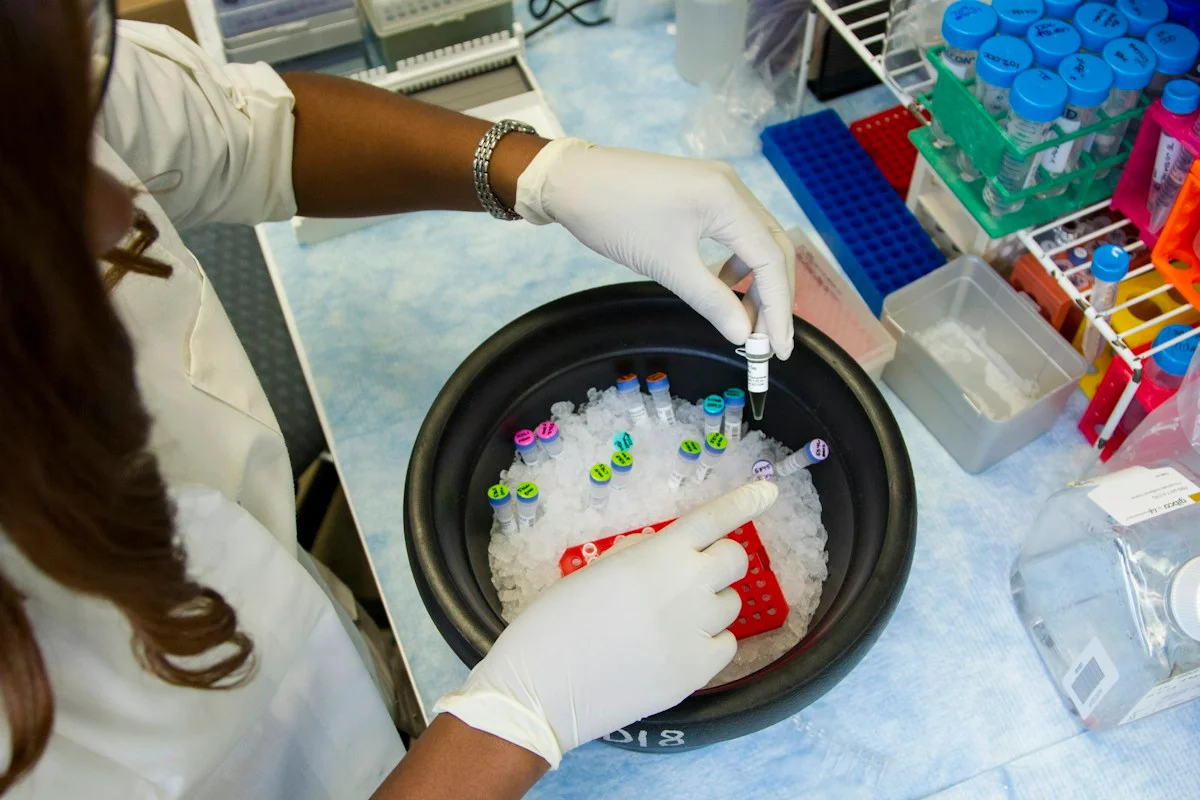
Illustrative photo · not a video frame
The Royal Society · 44 min 28 sec · Background explainer
Is this the AI future we want? | The Royal Society
YouTube loads only when you choose; playback starts when you press play.
A Royal Society discussion with Madhumita Murgia and biomedical engineer Alison Noble on AI’s potential in healthcare, science and culture, recorded at the 30 June 2026 event.
Evidence check: A discussion of opportunities and risks, including future possibilities. It is not evidence that every application described is available or clinically proven.
Published 2026-07-01. Source checked 14 October 2026. Check captions on the publisher’s video page.
Check the healthcare evidencePhoto: Daniel Sone / National Cancer Institute / Unsplash · Licence
Evidence check
The cohort was retrospective and limited to 600 patients from 2019–2025; selection and diagnostic-label bias may affect performance.
No external hospital, prospective workflow or population-screening validation is reported in the accessible article record.
The study did not compare patient outcomes or clinician performance with and without the model.
Sensitivity was 79.7% at the chosen threshold, leaving a material false-negative risk in the reported evaluation.
The authors reported no external funding and declared no competing interests.
Reporting basis: Source analysis. Original source date: 21 October 2026.
Continue the story
Read next
Continue exploring clinical decision support: compare the finding and its evidence limits.
Can interpretable AI distinguish ovarian tumours before surgery?
A peer-reviewed retrospective study trained five classifiers on laboratory data from 349 patients at one Chinese hospital. Its best model reached 93.7% leave-one-out accuracy, but the small reused cohort and absence of external or prospective validation rule out clinical deployment.
Read the next reportExplore the full source and evidence record
What this means for people
- If independently validated, a laboratory-based model might support—not replace—assessment where specialist mental-health capacity is limited. Premature use could also miss depressed patients or medicalise people whose blood patterns resemble the training data.
Global context
The model comes from hospital laboratory data in China. Biomarker ranges, disease prevalence, referral patterns and access to confirmatory mental-health assessment differ across settings, making local external validation essential before clinical use.
What the evidence does not yet show
- The cohort was retrospective and limited to 600 patients from 2019–2025; selection and diagnostic-label bias may affect performance.
- No external hospital, prospective workflow or population-screening validation is reported in the accessible article record.
- The study did not compare patient outcomes or clinician performance with and without the model.
- Sensitivity was 79.7% at the chosen threshold, leaving a material false-negative risk in the reported evaluation.
- The authors reported no external funding and declared no competing interests.
What to watch next
- Independent multi-centre validation with a frozen model and threshold
- Performance by age, sex, medication, coexisting illness and severity
- Comparison against clinicians and validated screening instruments
- Prospective evidence on time to care, treatment decisions, safety and recovery
Living evidence record
Impact record IAI-0NPTST2
Evidence stage
Studied
Confidence
Supported
Reporting basis
Source analysis
Independent or research support
Present
Record status
Monitoring
Last checked
21 October 2026
Source trail
1 direct source across 1 source type.
People impact
Documented in this record.
Uncertainty
Limits and next checks are explicit.
Stages describe the evidence available—not whether a technology is good or bad. See the public method.
Single-source reporting disclosure
This record analyses one direct source. It can establish what Scientific Reports published or reported, but it is not independent corroboration of every performance claim or predicted outcome. The confidence label will change only when broader evidence is added.
Evidence trail
Sources used for this report
Links checked 21 October 2026
Research question, topics and regions
Whether routinely available laboratory variables could classify depression in patients aged 10–26 within a retrospective hospital dataset
Topics: Mental health · Young people · Clinical decision support · Blood tests · Model validation
Regions: China · Asia
This report is labelled source analysis. We summarise and analyse source material in our own words; company statements remain attributed claims until independently supported. Translated summaries preserve the meaning of the original source and link back to it. Read our editorial standards.
Reader commentary
What does this mean where you are?
Tell us what you have seen at work, in your community or in everyday life. A question is welcome too. No account is needed; we review notes before publishing them.
Explore commentary across the portal →Published reader notes
0No published reader notes yet. You can start the evidence-led discussion above.
Prefer a private correction or response? Contact the newsroom.